
Mol-Intel
What it is
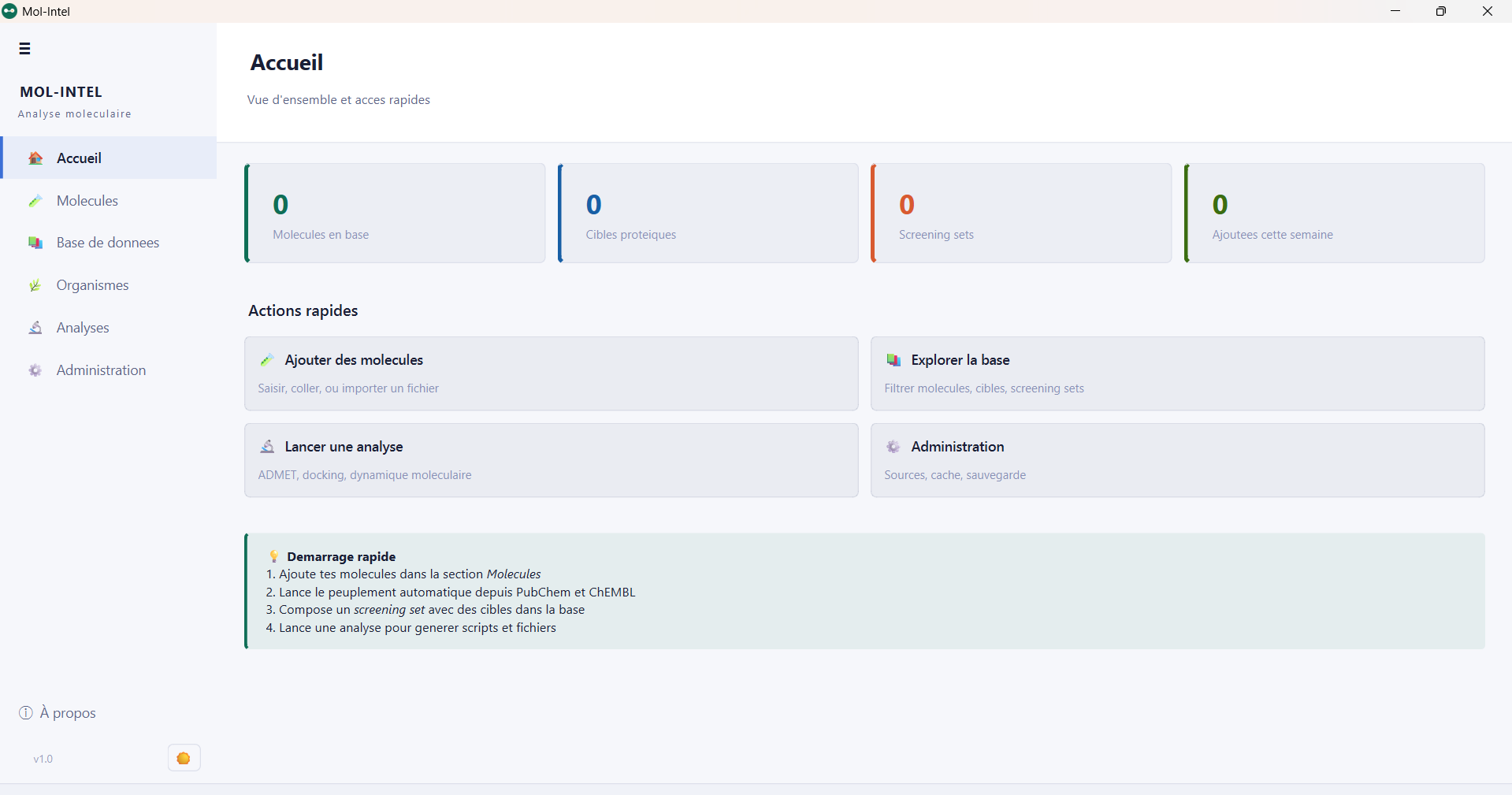
Mol-Intel is a desktop application (PySide6) I’m building for my PhD work on natural products. It aggregates data from ten scientific databases to enrich molecules, protein targets, and producing organisms from a single identifier, then assists with the downstream computational work: ADMET profiling, pocket detection, molecular docking, and dynamics preparation. At the time of writing, the app connects to PubChem, ChEMBL, ChEBI, COCONUT, NPASS (molecules), UniProt, PDBe, BindingDB (targets), and LOTUS + NPAtlas (organisms), with a local SQLite database that grows as I encode my targets and screening sets. The goal is to assist the researcher in two things:
- Investigating what is already known about a compound : bioactivities, validated targets, known mechanisms
- Preparing and exploiting computational analyses on those compounds: ADMET profiling, molecular docking, and molecular dynamics
Why I built it
Working on the anti-quorum sensing activity, I kept rebuilding the same workflow by hand for every new molecule and every new target: search PubChem for descriptors, then ChEMBL for bioactivities, then UniProt for the protein, then PDB for a structure, then prepare a docking grid by hand. Each loop ate an afternoon and the data ended up scattered across spreadsheets and folders. Mol-Intel turns that loop into a one-click pipeline:
- Molecule-first: paste an identifier → the app fans out to PubChem/ChEMBL/ChEBI/COCONUT/NPASS and consolidates everything in one row
- Target-first: enter a UniProt accession → sequence, functional sites, PDB structures, and top published inhibitors all come back together
- Organism-first: enter a plant or microbe → LOTUS and NPAtlas return every metabolite already published for that species, with bibliographic references
How it works
The app is organized as six sections in a desktop sidebar: Home, Molecules, Database, Organisms, Analyses, Administration. Under the hood, a relational schema (21 tables: molecules, targets, organisms, pockets, screening sets, identifiers, bioactivities, references…) backs everything, with a connector layer that handles rate limiting, retries, and offline fixtures for testing. The three useful pipelines stack naturally:
- Organisms → Molecules: pick a plant, populate from LOTUS, get 50–200 published metabolites with DOIs
- Targets → Pockets: pick a protein, fetch the UniProt annotations and a PDB, run FPocket to detect druggable cavities, and let the app classify each pocket as orthosteric or allosteric by cross-referencing the residues with the UniProt binding sites
- Both → Docking: build a screening set from the organism’s metabolites, copy a ready-made AutoDock Vina config from the pocket detail panel, and run docking externally
Each detected pocket comes with one-click exports: XYZ coordinates, full Vina config block, PyMOL selection script, and residue list.
Status
Working prototype. Personal research tool, local-first. This was partly vibe-coded to save time. I’m currently using it to build the structured dataset that backs my thesis on computational screening. A cleaned-up open-source release will likely follow once the schema stabilizes and the docking workflow is integrated.